

The GCC Maturity Model: Evolving From Cost Centre to an Innovation Hub
8 min read

There was an era when a CEO’s reason for opening an offshore centre in India began and ended with one objective, which was cutting costs. On the contrary, when you discuss the same with a business leader today, cost is barely part of the conversation. Instead, you hear conversations around driving cutting-edge product development, scaling AI initiatives, world-class engineering, and shaping global strategy.
Global Capability Centres (GCCs) have changed, or you can say evolved and have climbed up the ‘Maturity’ chain. India’s GCC ecosystem is moving beyond cost arbitrage as global enterprises are now shifting high-value engineering, product, AI and strategy work to the country.
Though, the size alone is not at the centre of the strategy. The GCC maturity model shows you exactly where your centre stands today and what you can change to evovle.
What do you mean by the GCC Maturity Model?
The GCC maturity model is a structured framework that describes how a centre evolves from a cost-focused execution unit into a strategic, innovation-led entity of the larger enterprise. Essentially, it tracks four things, namely, who sets priorities, who makes decisions, who carries accountability, and how deeply the enterprise trusts the centre.
A mature GCC executes and plans with more authority and decision-making power. This model is like a career ladder for the centre.
Several firms have their own versions of this. KPMG’s model, which NASSCOM’s community discusses, assesses how clearly GCC objectives link to global strategic priorities and how seamlessly the centre works as an extension of the parent.
The labels might differ, but every version points the same way, where the GCC moves ahead from executing tasks to owning outcomes.
Why should your GCC mature beyond the Cost Centre model
Labour arbitrage would have justified the first wave of GCCs, but it cannot promise sustained growth. You need measurable returns, your business units want faster execution, your talent demands real ownership, and your customers constantly look for better products.
Cost-centre GCCs show recognisable symptoms, like, headquarters keeps every decision, delivery feels transactional, career paths narrow, and trust erodes.
Most centres still have a long way to reach this kind of maturity.
The Five Stages of the GCC Maturity Model
Most frameworks converge on five stages and for each one, you will find what it looks like and also you will understand the move that unlocks the next stage.
Stage 1: Cost Centre
The centre does the work that’s handed over.
At this stage, you open the GCC to lower your operating costs. Your teams can complete the defined tasks, and you asses them on how cost effectively and at speed they can complete the tasks. The headquarters makes every decision, and the team is hardly in the loop of any strategic decisions or understand the outcomes.
To move ahead in this phase, leaders can explain the business goals behind the work and give the centre a first set of results it can own, such as a customer response time or a monthly close process.
Stage 2: Execution Partner
The centre can be depended on to complete the tasks effectively, but you still set the direction.
Now the centre delivers consistently. You agree on what it handles, it runs its own processes, and it hits quality targets on schedule. You can count on it, which is a real progress. The centre still follows your plan. However, still it has no say in the strategic outlook or business benefit of the task.
You can step further at this stage by choosing one process, such as invoicing or customer onboarding, and let the centre take its decisions, redesign, and make things work.
Stage 3: Capability Builder
Here, the centre becomes an expert you can trust.
This stage is the turning point. The centre can build deep expertise in its field, and its managers have grown strong enough to run teams without constant guidance from the HQs. Your business’s stakeholders can trust their judgements, and the teams are able to solve their issues independently.
For the first time, the centre does not focus on the speed of the work but is independent.
At this stage you can move ahead by investing in your people. By hiring specialists, setting up training programmes for your key domains, grooming your managers, and rotating the staff across the headquarters to encourage cross-learning initiatives.
Stage 4: Value Creator
The centre answers for results, not just effort.
The centre owns the products or platforms, from the first idea to the outcome. Instead of just task completion, you assess the centre based on the business results, such as revenue growth or customer satisfaction. Its teams work across departments, and its leaders take responsibility for the outcome. Eventually, your business units stop treating it as a supplier and start treating it as a partner.
To move forward, hand the centre’s leaders the product plans, and align their targets with the business results.
Stage 5: Strategic Innovation Hub
The centre is involved in the next move of the organization.
At full maturity, the centre owns the entire business areas end-to-end. It is involved in the planning of the the company’s direction, and it has a senior leadership who stand alongside your HQs key executive team. It innovates with products, patents, AI tools and better customer experiences. And it stays accountable for the long-term results.
To stay at this level, give the centre a seat in your annual planning, and give it a budget that it can control for the enterprise to move ahead globally.
How to move up the GCC Maturity Curve?
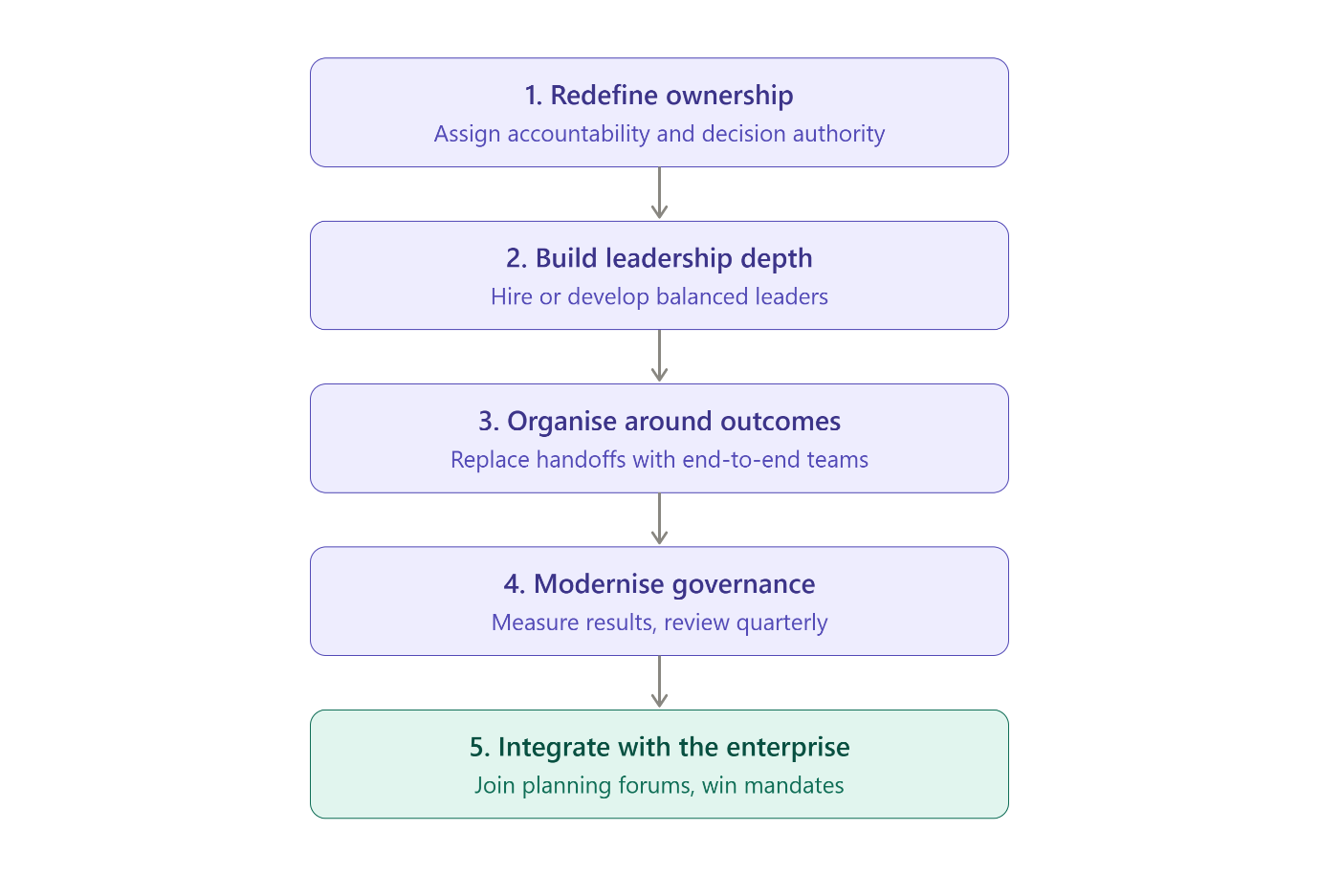
What are the common Pitfalls and how can you fix them?
You add headcount without adding ownership. Instead, you can tie every expansion to a new outcome the GCC owns.
You measure activity instead of outcomes. Instead, you can replace volume metrics with business KPIs.
You keep every decision at headquarters. Instead, you can publish a decision-rights matrix, and delegate in stages.
You treat the GCC like a vendor. Instead, you can invite the centre’s leaders for strategy sessions and share the credit for the results they have achieved as a team.
The GCC maturity model works like a mirror. It shows that the road from a cost centre to an innovation hub goes through ownership, trust and accountability, and not through office space or headcount. Assess your centre honestly, fix governance first, and give your GCC real mandates. You will turn a line item into a source of competitive advantage.
Know the maturity level of your GCC. At Enablr, we are ready to meet you where you are in your journey. Get started today.
<section class="faq-section"> <div class="faq-inner"> <div class="faq-side fi v"> <div class="eyebrow">FAQs</div> <h2 class="sh2">Related questions</h2> <p class="sp"> Straight answers on GCC maturity, end-to-end ownership, speed to market, talent, and where to start. </p> <a href="https://www.gccenablr.com/contact/" class="btn-primary">Talk to Us →</a> </div> <div class="faq-list fi v"> <!-- FAQ 1 --> <div class="faq-item"> <div class="faq-q" onclick="toggleFaq(this)" aria-expanded="false"> <span class="faq-q-text">What business value does a mature GCC deliver beyond cost savings?</span> <span class="faq-toggle"> <svg viewBox="0 0 24 24"> <line x1="12" y1="5" x2="12" y2="19"></line> <line x1="5" y1="12" x2="19" y2="12"></line> </svg> </span> </div> <div class="faq-a"> <div class="faq-a-inner"> A mature GCC gives you faster product delivery, stronger engineering capability, and a team that owns results instead of waiting for instructions. Your business units stop escalating every decision to headquarters, and your leaders spend their time on strategy rather than supervision. Over time, the centre becomes a source of new products, better customer experiences, and competitive advantage rather than a line item in your budget. </div> </div> </div> <!-- FAQ 2 --> <div class="faq-item"> <div class="faq-q" onclick="toggleFaq(this)" aria-expanded="false"> <span class="faq-q-text">How do I know whether my GCC is ready to own a product or a process end to end?</span> <span class="faq-toggle"> <svg viewBox="0 0 24 24"> <line x1="12" y1="5" x2="12" y2="19"></line> <line x1="5" y1="12" x2="19" y2="12"></line> </svg> </span> </div> <div class="faq-a"> <div class="faq-a-inner"> Look at how your centre behaves today. If its managers resolve issues without escalating, your business stakeholders trust its judgement, and its teams understand the business goals behind their work, the centre is ready. Start with one process or one product, give the team the decision authority to match, and track the results. A successful first handover tells you how quickly you can extend the same ownership to other areas. </div> </div> </div> <!-- FAQ 3 --> <div class="faq-item"> <div class="faq-q" onclick="toggleFaq(this)" aria-expanded="false"> <span class="faq-q-text">How does a mature GCC help me bring products to market faster?</span> <span class="faq-toggle"> <svg viewBox="0 0 24 24"> <line x1="12" y1="5" x2="12" y2="19"></line> <line x1="5" y1="12" x2="19" y2="12"></line> </svg> </span> </div> <div class="faq-a"> <div class="faq-a-inner"> A mature GCC removes the handoffs that slow your delivery. Instead of passing work between phases and teams, one end-to-end team owns the product from the first idea to the final outcome. That team makes decisions locally, fixes problems as they appear, and ships without waiting for approvals from another time zone. You gain speed because accountability and authority sit in the same place. </div> </div> </div> <!-- FAQ 4 --> <div class="faq-item"> <div class="faq-q" onclick="toggleFaq(this)" aria-expanded="false"> <span class="faq-q-text">How does maturity help me attract and retain strong talent in my GCC?</span> <span class="faq-toggle"> <svg viewBox="0 0 24 24"> <line x1="12" y1="5" x2="12" y2="19"></line> <line x1="5" y1="12" x2="19" y2="12"></line> </svg> </span> </div> <div class="faq-a"> <div class="faq-a-inner"> Skilled professionals stay where they can own meaningful work, grow into leadership, and see the impact of their decisions. A cost-centre GCC offers narrow career paths and little ownership, so strong people leave for roles that offer more. When you give your GCC real mandates, clear growth paths, and leaders who sit alongside headquarters executives, you build a team that stays, grows, and attracts others like it. </div> </div> </div> <!-- FAQ 5 --> <div class="faq-item"> <div class="faq-q" onclick="toggleFaq(this)" aria-expanded="false"> <span class="faq-q-text">What should I do first to move my GCC up the maturity curve?</span> <span class="faq-toggle"> <svg viewBox="0 0 24 24"> <line x1="12" y1="5" x2="12" y2="19"></line> <line x1="5" y1="12" x2="19" y2="12"></line> </svg> </span> </div> <div class="faq-a"> <div class="faq-a-inner"> Begin by assessing where your centre stands today. Ask who owns the outcomes of key initiatives, where final decisions sit, and how you measure your GCC leaders. Your answers show your current stage and the gaps to close. Fix governance first, then hand the centre one clear outcome to own. At Enablr, we help you assess your stage and plan the next move, so you can start from where you are. </div> </div> </div> </div> </div> </section> <style> :root { --faq-ink: #12151c; --faq-body: #5a616f; --faq-line: #e6e8ec; --faq-accent: #4b3df6; --faq-bg: #fbfbfd; } * { box-sizing: border-box; } .faq-section { background: var(--faq-bg); font-family: 'Inter', 'Helvetica Neue', Arial, sans-serif; padding: 80px 24px; } .faq-inner { max-width: 1120px; margin: 0 auto; display: grid; grid-template-columns: 340px 1fr; gap: 64px; align-items: start; } .faq-side { position: sticky; top: 40px; } .eyebrow { font-size: 12px; font-weight: 700; letter-spacing: 1.5px; text-transform: uppercase; color: var(--faq-accent); margin-bottom: 14px; } .sh2 { margin: 0 0 12px; font-size: 32px; line-height: 1.15; letter-spacing: -1px; font-weight: 650; color: var(--faq-ink); } .sp { margin: 0 0 20px; font-size: 14px; line-height: 1.6; color: var(--faq-body); max-width: 38ch; } .btn-primary { display: inline-flex; align-items: center; gap: 6px; background: var(--faq-ink); color: #fff; text-decoration: none; font-size: 14px; font-weight: 600; padding: 12px 22px; border-radius: 999px; transition: background .2s ease, transform .2s ease; } .btn-primary:hover { background: var(--faq-accent); transform: translateY(-1px); } .faq-list { display: flex; flex-direction: column; } .faq-item { border-bottom: 1px solid var(--faq-line); } .faq-item:first-child { border-top: 1px solid var(--faq-line); } .faq-q { display: flex; align-items: center; justify-content: space-between; gap: 24px; padding: 22px 4px; cursor: pointer; user-select: none; } .faq-q-text { font-size: 16px; font-weight: 560; color: var(--faq-ink); line-height: 1.4; transition: color .2s ease; } .faq-q:hover .faq-q-text { color: var(--faq-accent); } .faq-toggle { flex: 0 0 auto; width: 28px; height: 28px; border-radius: 50%; border: 1px solid var(--faq-line); display: flex; align-items: center; justify-content: center; transition: background .25s ease, border-color .25s ease, transform .3s ease; } .faq-toggle svg { width: 14px; height: 14px; stroke: var(--faq-ink); stroke-width: 2; fill: none; transition: stroke .25s ease; } .faq-q[aria-expanded="true"] .faq-toggle { background: var(--faq-ink); border-color: var(--faq-ink); transform: rotate(135deg); } .faq-q[aria-expanded="true"] .faq-toggle svg { stroke: #fff; } .faq-q[aria-expanded="true"] .faq-q-text { color: var(--faq-ink); font-weight: 650; } .faq-a { display: grid; grid-template-rows: 0fr; transition: grid-template-rows .35s ease; } .faq-a-inner { overflow: hidden; font-size: 14.5px; line-height: 1.7; color: var(--faq-body); padding-right: 52px; } .faq-a-inner a { color: var(--faq-accent); font-weight: 600; text-decoration: underline; text-underline-offset: 3px; text-decoration-thickness: 1px; transition: color .2s ease; } .faq-a-inner a:hover { color: var(--faq-ink); } .faq-item.open .faq-a { grid-template-rows: 1fr; } .faq-item.open .faq-a-inner { padding-bottom: 22px; } .fi.v { animation: faqFadeIn .5s ease both; } @keyframes faqFadeIn { from { opacity: 0; transform: translateY(10px); } to { opacity: 1; transform: translateY(0); } } @media (prefers-reduced-motion: reduce) { .faq-a, .faq-toggle, .fi.v { transition: none; animation: none; } } @media (max-width: 900px) { .faq-inner { grid-template-columns: 1fr; gap: 32px; } .faq-side { position: static; } } @media (max-width: 520px) { .faq-section { padding: 56px 18px; } .sh2 { font-size: 26px; } .faq-q-text { font-size: 15px; } .faq-a-inner { padding-right: 0; } } </style> <script> function toggleFaq(qEl) { var item = qEl.closest('.faq-item'); var isOpen = item.classList.contains('open'); document.querySelectorAll('.faq-item.open').forEach(function (openItem) { if (openItem !== item) { openItem.classList.remove('open'); openItem.querySelector('.faq-q').setAttribute('aria-expanded', 'false'); } }); if (isOpen) { item.classList.remove('open'); qEl.setAttribute('aria-expanded', 'false'); } else { item.classList.add('open'); qEl.setAttribute('aria-expanded', 'true'); } } </script>
Ready to build your scalable GCC?
Connect with our experts to discuss how we can help you establish and scale a high-performing Global Capability Center tailored to your business needs.
Recent Insights

How Much Can You Actually Save With an India GCC? (2026)
Stabilized mid-market GCCs save 30 to 40 percent versus outsourcing and 60 to 70 percent versus US teams, reached in year two. The savings curve, what erodes it, and the number to promise a board.
Oct 12, 2026
4 min read

GCC vs Outsourcing vs BPO: Cost, Control, Knowledge (2026)
Outsourcing rents capacity; a GCC owns it, with your employees and your IP. Compare GCC vs outsourcing and BPO on cost, knowledge, control and flexibility.
Oct 12, 2026
4 min read

GCC Talent in India 2026: Mid-Level, AI and Attrition Gaps
India has 2,117 GCCs and 2.36M professionals, yet GCC talent gaps in mid-level, AI and retention roles persist. See the data and what leaders can do about it.
Oct 9, 2026
4 min read